
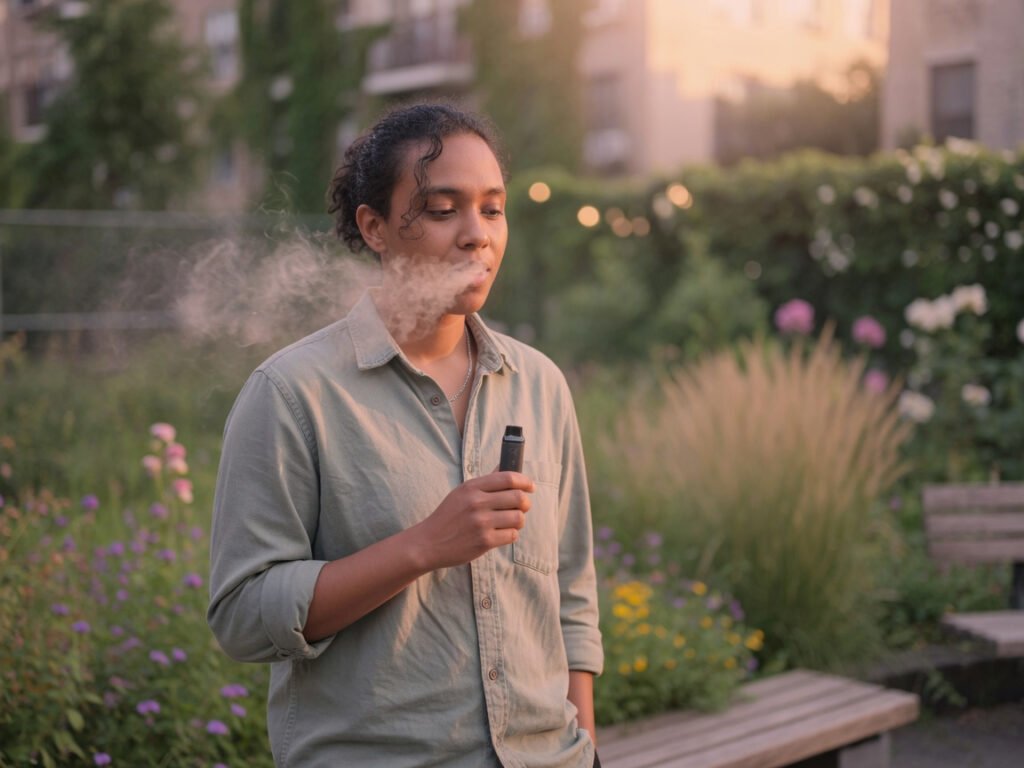
Does vaping reduce stress? In the moment, it genuinely can feel that way. But the science behind that sense of relief is more layered than a simple yes — and understanding what’s actually happening could change how you think about reaching for your device every time the pressure builds.
Key Findings at a Glance
- Consumer surveys consistently find that over half of UK vapers cite stress or anxiety relief as a primary reason they use their device.
- Nicotine triggers dopamine release within seconds of inhaling — creating real short-term calm — but it can quietly raise baseline anxiety over time.
- The ritual of vaping (slow breathing, stepping away, taking a break) may account for as much of the relief as the nicotine itself.
- Vaping is not a recognised long-term stress management tool, but for existing smokers who switch, it can reduce the psychological burden associated with cigarette use.
Why Do So Many People Reach for Their Vape When They’re Stressed?
There’s a reason the post-deadline vape or the after-argument break feels so automatic. Stress triggers a physical chain reaction — raised cortisol, a faster heart rate, tense muscles — and your brain immediately starts scanning for anything that has previously brought relief. If vaping has been part of your routine, the anticipation of that relief begins before you’ve even opened the pod.
UK vaping surveys have repeatedly found that stress and anxiety management rank among the top three reasons people vape, sitting alongside flavour enjoyment and quitting smoking. That’s a telling figure — it tells us the link between vaping and stress isn’t imagined. It’s a deeply conditioned behavioural response, shaped by the way nicotine interacts with the brain’s reward circuitry.
Nicotine is a pharmacologically unusual substance. It acts as both a stimulant and, at lower doses, a relaxant. Within seconds of inhaling, it binds to nicotinic acetylcholine receptors and triggers the release of dopamine — your brain’s primary “feel good” neurotransmitter. That rapid chemical reward is exactly what makes reaching for a vape feel almost instinctive under pressure.
What Does the Science Actually Say About Vaping and Stress?
The honest scientific picture is more complicated than a straight yes or no. Studies consistently show that people who use nicotine — through cigarettes, vapes, or patches — report feeling calmer after using. But researchers have long debated whether that calm represents genuine stress relief, or simply the resolution of nicotine withdrawal symptoms that have been accumulating since the last dose.
Research teams at major UK universities have found that people who quit nicotine entirely report lower anxiety and stress levels after a sustained period of abstinence than those who continue using. This suggests that nicotine use may be sustaining background anxiety rather than relieving it — and that the “relief” felt after vaping is largely the brain returning to its pre-withdrawal baseline, not reaching a calmer state than a non-user would naturally experience.
That said, vaping isn’t identical to smoking. Studies comparing the two indicate that vapers experience fewer of the acute stress spikes associated with the negative health feedback loop that cigarettes create. When you’re not worrying about 70-plus harmful chemicals in every puff, the psychological load of using your device is measurably lighter — and for former smokers who’ve switched, that alone can meaningfully reduce anxiety.
How Does Nicotine Actually Affect Your Stress Response?
To understand whether vaping reduces stress, you need to understand what nicotine actually does inside the brain and body. It’s not a straightforward relaxant. Its effects depend heavily on your current dependency level, your dose, how long it’s been since your last vape, and your individual brain chemistry.
Here’s what happens on a neurological level when you inhale:
- Nicotine reaches the brain within 10–20 seconds of inhaling — faster than most drugs taken by any other route.
- It binds to nicotinic acetylcholine receptors spread across multiple brain regions involved in mood and attention.
- This triggers a cascade of neurotransmitter releases, including dopamine, serotonin, and norepinephrine.
- Dopamine creates a reward signal — you feel briefly better, more focused, calmer.
- Norepinephrine, however, is a stress hormone. Higher doses of nicotine can actually increase heart rate and blood pressure — both physical markers of stress.
- Over time, the brain downregulates its natural dopamine production, meaning you need more nicotine just to feel normal — let alone genuinely calm.
The key insight here is that the calming effect is real but conditional. It’s most pronounced in regular users, and it largely reflects satisfying an established dependency — not creating a genuinely lower-stress state than a non-user would have. That distinction is easy to miss in the moment, but it matters enormously for how you think about vaping long term.
Is It the Nicotine — or the Ritual — That’s Actually Helping?
One of the most fascinating findings in vaping research involves nicotine-free e-liquids. Several studies have found that people report similar levels of stress relief when vaping 0mg nicotine e-liquid compared to nicotine-containing products, at least in the short term. That strongly suggests the ritual itself is doing a significant amount of the work.
Think about what vaping actually involves physically: you step away from whatever is stressing you, you focus on a simple and repetitive physical action, you take slow and deliberate deep breaths, and you give yourself a defined pause. That’s essentially a mindfulness micro-session built into your day. The slow, controlled inhalation activates your parasympathetic nervous system — your body’s “rest and digest” mode — and that physiological shift alone can meaningfully reduce cortisol levels.
Behavioural psychology research consistently shows that controlled breathing for as little as 60–90 seconds can produce a measurable reduction in subjective feelings of stress. If your vaping habit involves three to five minutes of slow rhythmic breathing, you’re getting a real portion of that benefit regardless of what’s in the tank. This matters practically: it means that lowering your nicotine strength, or switching to a 0mg option, doesn’t necessarily mean losing all the stress-relief benefit — because a good chunk of that benefit was never about the nicotine in the first place.
Does Vaping Help with Anxiety as Well as Stress?
Stress and anxiety are related but meaningfully different. Stress is usually triggered by an identifiable external pressure — a work deadline, a difficult conversation, a financial worry. Anxiety is an internal state that often persists even when external triggers aren’t obviously present. That distinction matters when you’re asking whether vaping helps.
For acute situational stress, the argument for vaping’s short-term relief is at least partially supported by evidence. For ongoing anxiety disorders, the picture looks considerably worse. Research covering mental health and substance use has found that regular nicotine users are significantly more likely to report symptoms of generalised anxiety — and that nicotine dependence and anxiety disorders tend to reinforce each other in a cycle that’s genuinely hard to break.
People with anxiety often use vaping as their primary coping mechanism, which can make quitting feel impossible: nicotine withdrawal itself mimics anxiety symptoms, making it feel like the vaping was definitively “working.” This is one of the more insidious aspects of nicotine dependency when it overlaps with anxiety, and it’s a pattern that clinicians working in this space see regularly.
“The relief people feel from nicotine is largely the brain returning to its pre-withdrawal baseline — not reaching a more relaxed state than a non-user would naturally experience.”
— Behavioural neuroscience research consensus
What Do Vapers Actually Report About Stress Relief?
Survey data from the UK vaping community tells a consistent story. Vapers describe the experience of reaching for their device when stressed in remarkably similar terms: a sense of pause, physical release, and mental reset. The specifics differ — some describe it as a “breathing space,” others as a simple habit that marks a clear transition between stressful moments and relative calm.
Consumer research in the UK vape market has found that a large majority of vapers who use their device for stress relief say they would continue vaping even at significantly reduced nicotine levels, provided they could maintain the same routine and ritual. That’s a telling finding — it aligns closely with what the controlled studies suggest about the importance of the behavioural component.
Of course, self-reported survey data has limitations. People often rationalise habitual behaviour, and the perception of stress relief doesn’t always match objective physiological measures. But as a consistent signal of how vaping functions in people’s everyday lives — as a pause button as much as a nicotine delivery system — the survey evidence is hard to dismiss.
Vaping vs. Other Stress Relief Methods: How Does It Stack Up?
Placing vaping alongside other common stress management approaches helps put its benefits and limitations in honest perspective. The comparison below covers five dimensions that matter when you’re evaluating a stress tool:
| Method | Speed of Relief | Long-Term Effectiveness | Health Impact | Dependency Risk |
|---|---|---|---|---|
| Vaping (nicotine) | Very fast (10–20 sec) | Low–Moderate | Mixed (less harmful than smoking) | High |
| Deep breathing / breathwork | Fast (1–3 min) | High | Positive | None |
| Exercise | Slower (15–30 min) | Very High | Very Positive | Low |
| Meditation / mindfulness | Moderate (5–10 min) | Very High | Positive | None |
| Nicotine-free vaping | Moderate (ritual effect) | Low–Moderate | Largely neutral (ongoing research) | Very Low |
| CBD vaping | Moderate | Uncertain | Under-researched | Low |
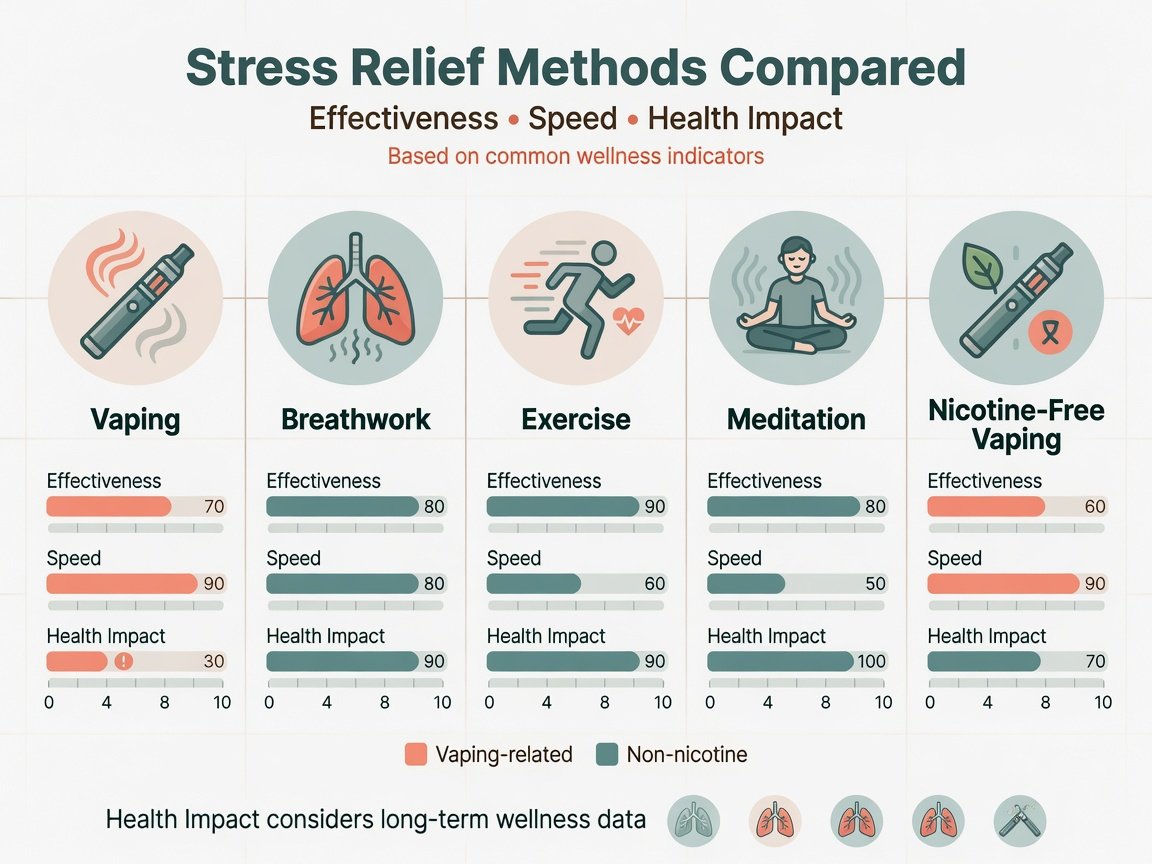
Vaping scores well on speed — few stress-relief tools work as quickly. But it scores poorly on long-term effectiveness and dependency risk compared to lifestyle-based approaches. That’s not a condemnation; it’s an honest framing that helps you make better choices about when and why you reach for your device.
Short-Term Relief vs Long-Term Stress Management: What’s the Difference?
One of the most important distinctions in the vaping-and-stress conversation is the gap between short-term relief and long-term stress management. Vaping — like alcohol, comfort food, or social media scrolling — can provide genuine short-term relief. The problem is that none of these approaches reduce the underlying stressors, or build your capacity to handle them better over time.
Long-term stress management involves actually changing how your nervous system responds to stressors — through consistent practices like regular exercise, sleep hygiene, therapy, and mindfulness. These approaches have decades of robust clinical evidence behind them. They demonstrably reduce baseline cortisol, improve heart rate variability, and build the kind of psychological resilience that makes stressful events feel less overwhelming.
Vaping doesn’t build resilience. It provides relief in the moment, but it doesn’t change the underlying system. And the dependency element can introduce its own layer of background stress — the low-level anxiety about running out of e-liquid, managing nicotine intake around social situations, or navigating practical situations that limit when you can vape. If you travel frequently and rely on your device to take the edge off journey stress, for example, the rules around taking disposable vapes on planes are something every travelling vaper should know before they reach the departure gate.
If You Do Vape for Stress, How Can You Do It More Mindfully?
If stress relief is part of why you vape, there are practical ways to engage with that habit more intentionally — preserving the benefits while reducing the dependency over time. None of this requires cold-turkey willpower. It’s about making small, deliberate adjustments.
- Gradually reduce your nicotine strength. Moving from 20mg to 10mg, and eventually to 3mg or 0mg, preserves the ritual while reducing the neurochemical dependency. Many vapers find the stress-relief feeling persists even at lower nicotine levels — because so much of it was the ritual all along.
- Pair vaping with deliberate breathwork. Use your vaping break as a proper breathing session — try a 4-count inhale, 4-count hold, 6-count exhale pattern. You’ll amplify the parasympathetic response and get more genuine calm from the same break.
- Set a time delay when stressed. Before automatically reaching for your vape, try a 5-minute delay rule. Use those five minutes for a brief walk or a breathing exercise. You’ll often find the urge was more about habit than genuine need — and you’ll slowly build alternative coping responses.
- Distinguish between stress and cravings. Before you vape, ask yourself honestly: am I stressed, or am I feeling nicotine withdrawal? They feel similar — but the answers point in different directions.
- Build a parallel toolkit. Vaping can coexist alongside other stress management tools without conflict. Regular movement, better sleep, and even ten minutes of daily breathwork can significantly reduce baseline stress — making your vaping breaks feel less urgent and more like a genuine choice.
What Do Experts Say About Using Vaping as a Stress Tool?
Mental health professionals and public health researchers are broadly consistent in their position: vaping is not a recommended stress management strategy — but the picture is more nuanced than a flat dismissal.
Many clinicians working in smoking cessation acknowledge that for people switching from cigarettes, vaping represents a meaningful harm reduction step. The UK Health Security Agency has consistently maintained that vaping is significantly less harmful than smoking, and for smokers who are using cigarettes partly to manage stress, switching to vaping is a rational, evidence-supported move — even if it’s not the ultimate answer to the underlying stress.
The expert consensus becomes considerably less favourable when the question shifts to non-smokers. Introducing a nicotine dependency specifically to manage stress is, in clinical terms, trading one problem for another. The stress management benefits simply don’t outweigh the risks of establishing a new and potentially lasting dependency in someone who had none to begin with.
Researchers studying young adult vaping patterns are particularly concerned about this dynamic. Data consistently shows that young people are significantly more likely than older adults to cite stress and anxiety as their primary motivation for starting to vape — and this is a population where the risk-benefit calculation looks materially worse than it does for adult smokers switching devices. The younger the user and the longer the likely usage period, the more the dependency risks compound.

Frequently Asked Questions About Vaping and Stress
Does vaping actually calm you down, or is it just placebo?
It’s a bit of both, honestly. Nicotine does produce a real neurochemical response that can create a sense of calm — particularly in regular users. But research shows that much of the perceived relief is the resolution of withdrawal symptoms, and the breathing ritual of vaping independently contributes to the calming effect. So it’s not purely placebo, but it’s also not as simple as nicotine equals calm.
Can vaping make stress and anxiety worse in the long run?
Yes, it can — and this is one of the most consistent findings in the research. Regular nicotine use is associated with higher baseline anxiety levels over time. The dependency creates a low-level stress state that only vaping can resolve, which means you may gradually be producing the very anxiety you’re reaching for your device to relieve. Heavier and longer-term use tends to correlate with more anxiety, not less.
Is nicotine-free vaping better for stress relief?
Nicotine-free vaping avoids the dependency cycle entirely while still preserving the breathing ritual that delivers genuine calming benefits. Many vapers report very similar stress-relief feelings at 0mg — suggesting the ritual was doing most of the heavy lifting all along. For people who enjoy vaping but want to step down their nicotine intake, 0mg e-liquids are a practical and underrated option.
Why do I feel more anxious and stressed when I can’t vape?
That’s nicotine withdrawal making itself felt. When your nicotine levels drop below a certain threshold, your brain triggers a mild stress response — irritability, difficulty concentrating, and a sense of background unease. These are withdrawal symptoms, not your baseline. The relief you feel when you vape is those symptoms resolving, which your brain interprets as the stress going away — when in fact, the vaping created both the problem and the solution.
Should I start vaping to help manage my stress?
If you’re a non-smoker, the answer from the research community is a consistent no. Introducing a nicotine dependency to manage stress is likely to increase your overall anxiety burden over time rather than reduce it. Evidence-based stress management approaches — regular exercise, breathwork, therapy, and improved sleep — produce genuine long-term relief without dependency risk. If you’re an existing smoker looking to reduce harm, switching to vaping is a different and more nuanced conversation worth having with your GP.
How quickly does vaping reduce stress symptoms?
Very quickly. Nicotine reaches the brain within 10–20 seconds of inhaling — faster than most drugs delivered by any other route. For regular users, the sense of calm typically peaks within one to two minutes and begins to fade after 15–30 minutes. This rapid onset is a significant part of why the habit becomes so ingrained: the reinforcement loop is fast, reliable, and consistent.
Are there specific vape flavours that help more with stress?
There’s no clinical evidence that specific e-liquid flavours produce measurable stress-relieving effects. Some vapers report that mint, lavender-inspired, or chamomile-adjacent flavours feel calming — but this is almost certainly an olfactory association rather than a pharmacological one. What matters more than flavour is the nicotine strength and the quality of the breathing ritual you build around your vaping habit.
The Bottom Line: Does Vaping Reduce Stress?
Yes — but probably not in the way it feels like it does, and probably not as much as it seems in the moment.
For regular vapers, the stress relief is real but largely reflects nicotine withdrawal resolving rather than a genuinely calmer state. The ritual of vaping — the breathing, the break, the pause it creates — contributes meaningfully to the calming effect and may be doing more work than the nicotine itself. And for former smokers who’ve switched, vaping can reduce anxiety by lifting the psychological weight of cigarette-related health concerns.
What vaping isn’t is a long-term stress management solution. It doesn’t build resilience, it doesn’t address the sources of stress, and the dependency cycle can introduce its own layer of background anxiety over time. If you already vape and stress relief is part of your reason for doing so, the most useful step is pairing it with other tools — better sleep, regular movement, and simple breathing practices — rather than relying on it as your only coping mechanism.
And if you’re considering vaping purely to manage stress and you don’t currently smoke, the evidence base says the tools that actually work long-term don’t come with dependency attached.
This article is intended for informational purposes only and does not constitute medical advice. If you are experiencing significant or persistent stress or anxiety, please speak with a qualified healthcare professional.
“`json
Leave a Reply