
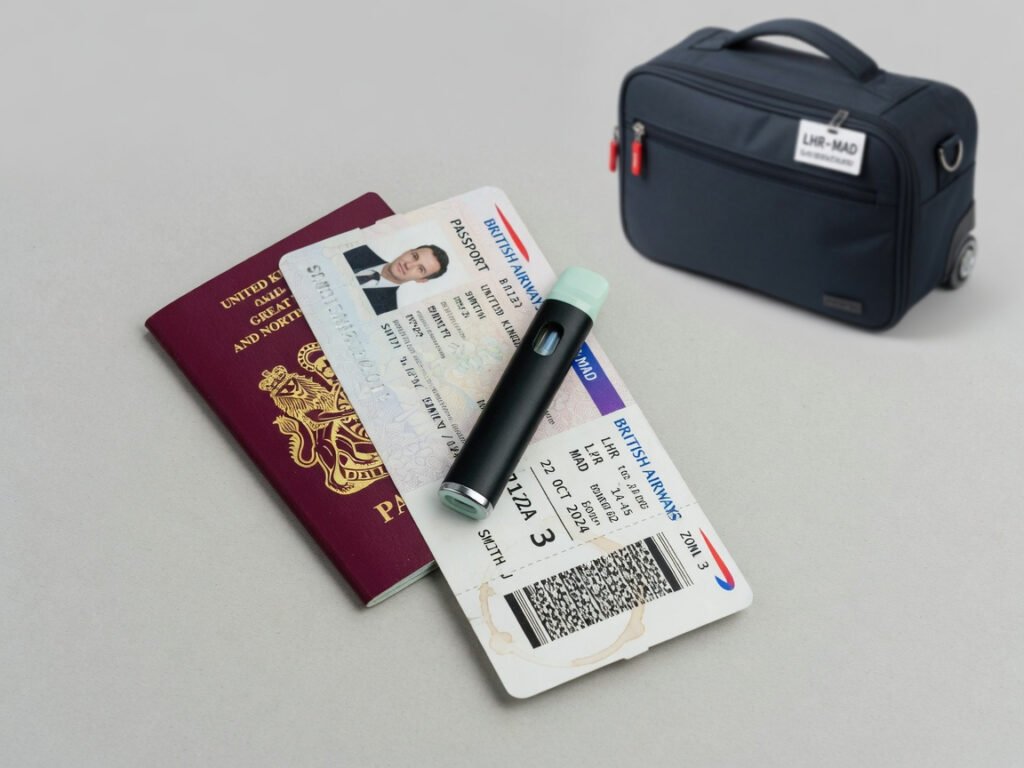
Yes — disposable vapes are allowed on planes, but only in your carry-on bag, never in the hold. That single rule trips up thousands of travellers every year and leads to confiscated devices, delayed bags, and in some destinations, serious legal trouble. Here is everything you need to know before you fly in 2026.
- Carry-on bag: ✓ Allowed — disposable vapes are permitted in hand luggage on virtually all commercial flights worldwide.
- Checked luggage: ✗ Banned — lithium batteries in vaping devices are prohibited in aircraft holds by global aviation law.
- Vaping on board: ✗ Strictly forbidden — using a vape mid-flight is treated the same as smoking and carries significant penalties.
- Destination rules matter: at least ten countries ban vapes entirely in 2026, including Thailand and Singapore, where penalties can be severe.
What Is the Golden Rule for Disposable Vapes on Planes?
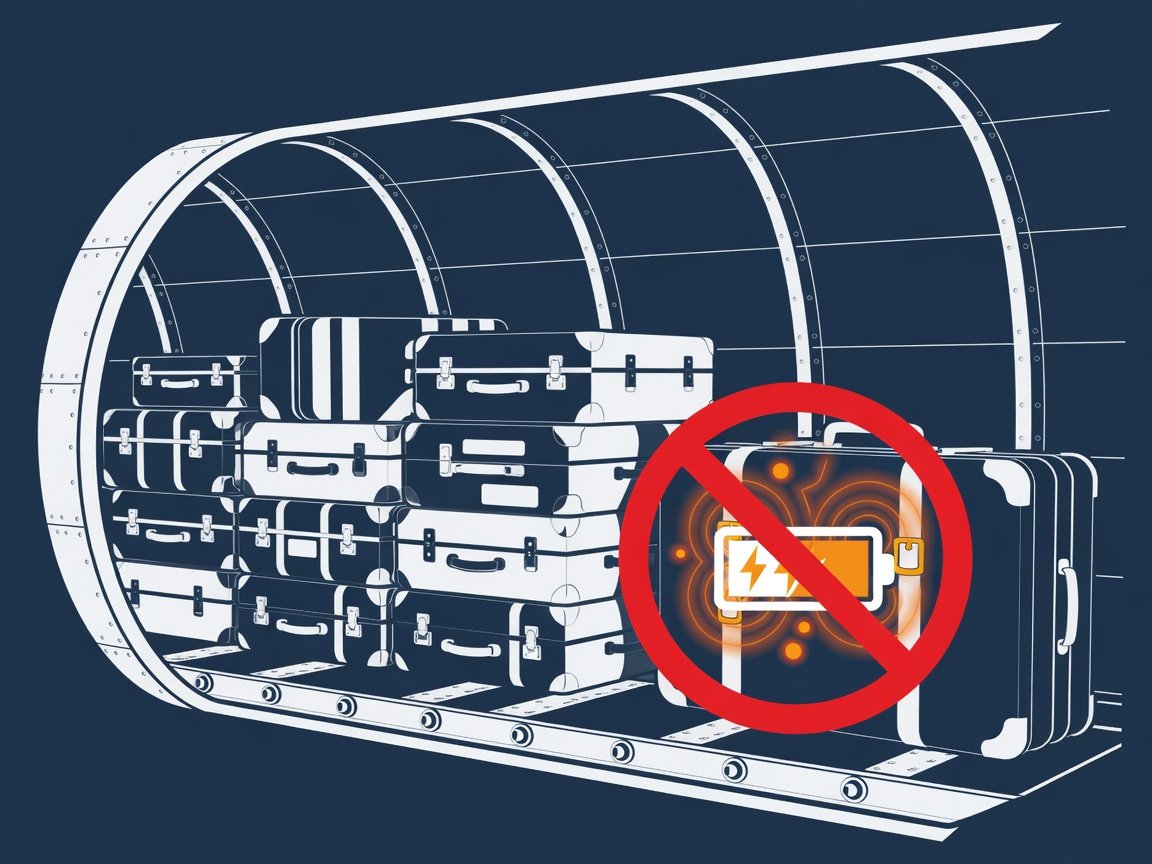
The universal rule is straightforward: vaping devices travel in the cabin, not the cargo hold. This applies to disposable vapes, pod kits, mods, and every other type of electronic nicotine delivery device. IATA — the International Air Transport Association — sets the dangerous goods regulations that almost all airlines follow worldwide, and those regulations are unambiguous: e-cigarettes containing lithium batteries must be carried in the passenger cabin only. They cannot be placed in checked baggage under any circumstances.
The reason is not arbitrary bureaucracy. Lithium batteries can overheat and ignite through a process called thermal runaway. In the passenger cabin, crew can detect and respond to a fire immediately. In the unpressurised, unmonitored cargo hold, the same fire can go undetected until it becomes catastrophic. IATA’s own incident data consistently places lithium battery fires among the most dangerous in-flight risks — which is exactly why the carry-on-only rule exists and why airlines enforce it without exception.
of all in-flight smoke, fire, and extreme heat incidents reported to IATA are linked to lithium battery–powered devices, making them the single largest category of in-flight dangerous goods incident.
The team at vapeshopsuk.com regularly hears from vapers who were caught out by this rule. The most common assumption is that because a disposable vape is small, it can go anywhere. It cannot. The size of the device is irrelevant — what matters is the lithium battery inside it, however compact.
Why Are Disposable Vapes Banned from Checked Luggage?
The checked baggage ban exists entirely because of lithium battery fire risk. When a device is stowed in the hold, it is inaccessible to crew, not subject to temperature regulation, and hidden from any monitoring system. If a lithium battery enters thermal runaway in the hold — triggered by pressure changes, temperature swings, a short circuit, or physical damage — the consequences can be severe before anyone even knows something is wrong.
IATA’s Dangerous Goods Regulations, updated annually and adopted into national aviation law across all major markets, classify portable electronic devices with lithium batteries as restricted items in checked baggage. These rules are enforced by the UK Civil Aviation Authority, the US Federal Aviation Administration, and the European Union Aviation Safety Agency. This is not a preference that varies by airline — it is a legal requirement across the global aviation system.
Aviation incident databases consistently show that the majority of lithium battery fires on aircraft occur in the cargo hold, even though passengers carry far more batteries into the cabin. The difference is that hold fires go undetected. In 2025 alone, the FAA recorded dozens of lithium battery–related incidents globally, reinforcing why this rule remains non-negotiable heading into 2026.
What Do UK Airlines Say About Vapes on Flights in 2026?
Every major UK carrier — British Airways, easyJet, Ryanair, Jet2, and TUI — follows the same basic framework: vaping devices in the cabin, not the hold, and no vaping during the flight. The policies are nearly identical because they all derive from the same IATA dangerous goods rules and UK CAA guidance. That said, there are nuances worth knowing before you travel.
British Airways permits e-cigarettes in hand luggage only, specifying that devices should be switched off and protected against accidental activation. For disposable vapes without a power button, the airline advises placing them in a sealed bag or case. easyJet’s policy mirrors this, adding that passengers are personally responsible for ensuring devices do not activate during the flight. Ryanair is explicit: e-cigarettes, including single-use disposables, must not be placed in hold luggage under any circumstances.
| Airline | Carry-on | Checked Bag | Quantity Limit | Use on Board |
|---|---|---|---|---|
| British Airways | ✓ Allowed | ✗ Banned | No stated limit | ✗ Banned |
| easyJet | ✓ Allowed | ✗ Banned | No stated limit | ✗ Banned |
| Ryanair | ✓ Allowed | ✗ Banned | No stated limit | ✗ Banned |
| Jet2 | ✓ Allowed | ✗ Banned | No stated limit | ✗ Banned |
| TUI | ✓ Allowed | ✗ Banned | No stated limit | ✗ Banned |
| Emirates | ✓ Allowed | ✗ Banned | No stated limit | ✗ Banned |
One significant 2025 development that affects UK travellers: the UK banned the manufacture and sale of single-use disposable vapes from June 2025 under environmental protection legislation. This does not affect your right to travel with a device you already own, but it does mean fewer UK vapers are carrying brand-new disposables purchased domestically. Travellers returning to the UK from countries where disposables remain on sale should also be aware that UK customs allows a personal import allowance of up to 200ml of e-liquid — quantities above that may be questioned.
What Are the TSA Rules for Disposable Vapes on US Flights?
The Transportation Security Administration is unambiguous: e-cigarettes and vaping devices are permitted in carry-on baggage and on your person, but are not allowed in checked luggage. This aligns with FAA regulations, which prohibit lithium battery–powered devices in the hold on all flights operating under US aviation authority. The rule applies to domestic US flights and international flights departing from the United States.
The TSA does not publish a quantity limit for disposable vapes in carry-on bags. At US airport security checkpoints, vaping devices pass through X-ray scanners alongside other personal electronics. You do not need to remove them from your bag separately, though security officers may ask questions if a device triggers additional screening. According to TSA checkpoint data reviewed in 2025, vaping devices are among the most frequently declared personal electronics at US security points — and awareness of the carry-on rule has increased significantly year on year as vaping has become more mainstream.
US domestic and international flights follow identical rules on this point. If you are flying from the US to Europe, both FAA and EASA regulations apply at different points in the journey — and both say exactly the same thing. Carry-on only, no exceptions.
Can You Actually Vape on a Plane?
No. Vaping on a commercial flight is universally prohibited. Every airline in the world bans it, and aviation law in all major jurisdictions — the UK, US, EU, and beyond — treats using a vaping device on a flight as legally equivalent to smoking. The same penalties apply, which are substantial.
Modern aircraft have highly sensitive smoke detection systems throughout the cabin and in all lavatories. These systems are capable of detecting vapour, not just combustion smoke. There is a persistent myth that vaping “fools” aircraft detectors — it does not. Multiple documented incidents exist of passengers detected vaping in aircraft lavatories who faced immediate removal from the flight, airline bans, and legal proceedings. The risk is entirely disproportionate to any perceived benefit.
The maximum fine a passenger can face for smoking or vaping on a commercial flight in the UK under the Air Navigation Order — before any additional charges, compensation claims, or airline-imposed bans.
Some airports do have designated vaping areas landside — before security — where use is permitted. Once airside, most airports apply the same no-vaping rules as the aircraft themselves, though a small number maintain indoor smoking rooms that also permit vaping. Check the specific policy of your departure airport before you travel. The practical rule of thumb: if you cannot smoke there, you cannot vape there.
How Do You Pack a Disposable Vape for a Flight?
Packing correctly keeps you compliant with aviation rules, protects your device from leaks at altitude, and makes the security process smooth. Follow these steps before every flight.
Which Countries Ban Disposable Vapes Completely?
This section may be the most important in this entire guide. Being permitted to carry a vape onto the plane does not mean you are permitted to have one at your destination. In 2026, at least ten countries maintain full or partial bans on vaping products — and several of them are popular holiday destinations from the UK. The consequences of arriving in a ban country with a vape range from simple confiscation to criminal prosecution.
| Country | Status in 2026 | Risk Level | Potential Consequence |
|---|---|---|---|
| Thailand | Complete ban | Very High | Fine up to 30,000 Thai baht (~£650); possible imprisonment up to 10 years |
| Singapore | Complete ban | Very High | Fine up to SGD $2,000; import can result in prosecution |
| India | E-cigarettes banned under PECA 2019 | High | Confiscation, fine, possible imprisonment |
| Brazil | Sale banned; enforcement variable | Medium | Confiscation; enforcement varies by region and border |
| Australia | Nicotine vapes require a prescription | Medium | Confiscation without valid Australian prescription |
| Japan | Nicotine e-liquid banned; non-nicotine permitted | Medium | Confiscation of nicotine-containing devices |
| UAE | Now legal for personal use (since 2023) | Low | Rules continue to evolve — verify current status before travel |
| USA | Legal with FDA and state-level restrictions | Low | Flavour bans in some states; age verification required |
| EU Countries | Legal if TPD-compliant | Low | Non-compliant products may be confiscated at customs |
Thailand deserves specific emphasis because it catches more UK travellers off guard than any other destination. It is one of the most popular long-haul holiday destinations from the UK and simultaneously one of the strictest countries in the world on vaping. Possession of any vaping device in Thailand can result in a fine of up to 30,000 Thai baht and potentially a custodial sentence. The ban is actively enforced. Tourists have been arrested and prosecuted. Do not travel to Thailand with any vaping device, regardless of how small or inconspicuous it appears.
What Happens If Airport Security Finds Your Vape in Checked Luggage?
When X-ray screening identifies a vaping device inside checked luggage, the bag is flagged and removed from the baggage handling system for manual inspection. This can happen at the origin airport, a transit hub, or at the arrival airport. In all cases, the vaping device will be removed and either confiscated or handed back to you airside — meaning you will not be able to take it on the flight.
The consequences extend beyond losing the device itself. Bag inspections take time. If the inspection happens close to departure, your bag may miss the flight. Some airlines charge rebooking or delay fees where a bag causes a missed connection on a tightly scheduled route. At airports with heavy baggage throughput, a flagged bag may not be reunited with its passenger until the next available service — sometimes 12 to 24 hours later.
In 2025, a family departing from Manchester for Málaga had their checked bag flagged at the security scan stage after a disposable vape was found inside. The bag was pulled for manual inspection, the device was confiscated, and the bag missed the outbound flight. The airline rerouted the luggage on the next available service — arriving at the destination 19 hours after the family. The family purchased essentials on arrival and spent several hours at the airline’s baggage desk. Total additional cost: approximately £140. The disposable vape that triggered the process had a retail value of less than £5. Checking your luggage before check-in takes less than two minutes.
A 2025 UK travel industry survey found that approximately 1 in 10 vapers who had taken a flight in the previous twelve months reported having a vaping device confiscated at some point during travel. The majority of those incidents resulted from accidentally placing the device in hold luggage rather than any deliberate intent to break the rules. Awareness is the fix — and it costs nothing.
How Do UK, EU, and US Airport Rules Actually Differ?
The core rule is consistent across all three jurisdictions — carry-on only, no vaping on board — but the way airports apply that rule, and what happens at the border on arrival, varies in meaningful ways that every vaping traveller should understand.
At UK airports, the liquids rule remains aligned with the long-standing standard: 100ml per container, all containers in a single transparent, resealable 1-litre bag. Since 2024, some UK airports have begun deploying advanced CT scanners at security lanes, which can in some cases allow liquids to remain in bags during X-ray. However, the 100ml per container rule applies regardless of scanner type — the CT technology changes the process, not the legal limit. UK customs also applies post-Brexit rules to arrivals from EU countries, meaning EU travellers no longer benefit from any separate allowance.
In the EU, the Tobacco Products Directive governs which vaping devices are legal to sell and carry across member state borders. Non-TPD-compliant devices — including many disposables produced for non-EU markets — can be confiscated at customs if found in quantity. TPD rules for disposable vapes specify maximum e-liquid capacity of 2ml, maximum nicotine concentration of 20mg/ml, and specific packaging and labelling requirements. In the US, the FDA’s Premarket Tobacco Application framework means that many vaping products sold outside the US are technically not authorised for import — though enforcement at the personal import level is inconsistent.
adults in the UK now use e-cigarettes, according to ASH (Action on Smoking and Health) 2025 data — making the UK one of the highest per-capita vaping populations in the world and one of the countries most significantly impacted by international travel restrictions on vaping products.
What Is Changing for Disposable Vape Travel Rules in 2026–2027?
The regulatory landscape for vaping is evolving faster than almost any other consumer product category. Travel rules are being reshaped by a combination of environmental legislation, public health policy, and aviation safety updates. Here is what to expect over the next two years.
In the UK, the Tobacco and Vapes Bill progressing through Parliament in 2026 proposes significant new restrictions on vaping products, including tighter controls on flavours, packaging, and nicotine concentrations. While air travel is not the bill’s primary focus, the broader regulatory direction signals that further restrictions on which products are legal to carry across international borders are likely before the end of 2027. The UK’s June 2025 ban on the manufacture and sale of single-use disposable vapes has already changed which devices UK travellers are likely to carry.
Internationally, several additional countries are expected to introduce or significantly tighten vaping restrictions before the end of 2027. Mexico has been reviewing its regulatory position on vaping products since 2025. New Zealand — which previously maintained relatively liberal vaping laws — is introducing stricter controls on single-use devices. And the European Commission’s anticipated revision of the Tobacco Products Directive, expected to be finalised around 2027, may further restrict the types of vaping devices that can legally move across Schengen borders.
countries are predicted by global tobacco control researchers to have comprehensive vaping bans or prescription-only regimes by 2027 — up from approximately ten in 2026. The direction of international vaping regulation is consistently tightening.
For air travel specifically, IATA’s Dangerous Goods Regulations are reviewed annually, and future editions may introduce explicit quantity limits for vaping devices in carry-on luggage, similar to the restrictions already in place for spare lithium batteries. Checking your specific airline’s current policy before every international trip — rather than relying on what applied last year — is not overcautious, it is practical.
Frequently Asked Questions About Disposable Vapes on Planes
Can I put a disposable vape in my checked luggage?
No. Disposable vapes contain lithium batteries and are banned from checked luggage on all commercial airlines worldwide. This is a global aviation safety regulation enforced by IATA, the UK CAA, the US FAA, and EASA. If airport security finds a vaping device in your checked bag, it will be confiscated. Always carry your vape in your hand luggage.
How many disposable vapes can I take on a plane?
There is no specific quantity limit set by IATA or most major airlines for vaping devices in carry-on luggage. However, carrying a large number of devices may attract scrutiny from customs officers, particularly if you are entering a country that restricts or bans vaping products. Customs authorities in any jurisdiction can classify unusually large quantities as commercial importation rather than personal use, which carries different legal implications. Carry what you reasonably need for your trip.
Can I vape in the airport before my flight?
It depends on the specific airport. Many UK airports have designated outdoor smoking and vaping areas landside — before the security checkpoint — where vaping is permitted. Once airside, most airports apply strict no-vaping rules indoors, though some maintain smoking rooms that also permit vaping. Vaping in a non-designated area of a UK airport can result in a fixed penalty notice of up to £200. Always check the policy of your specific airport before you travel.
Will my disposable vape leak on a plane?
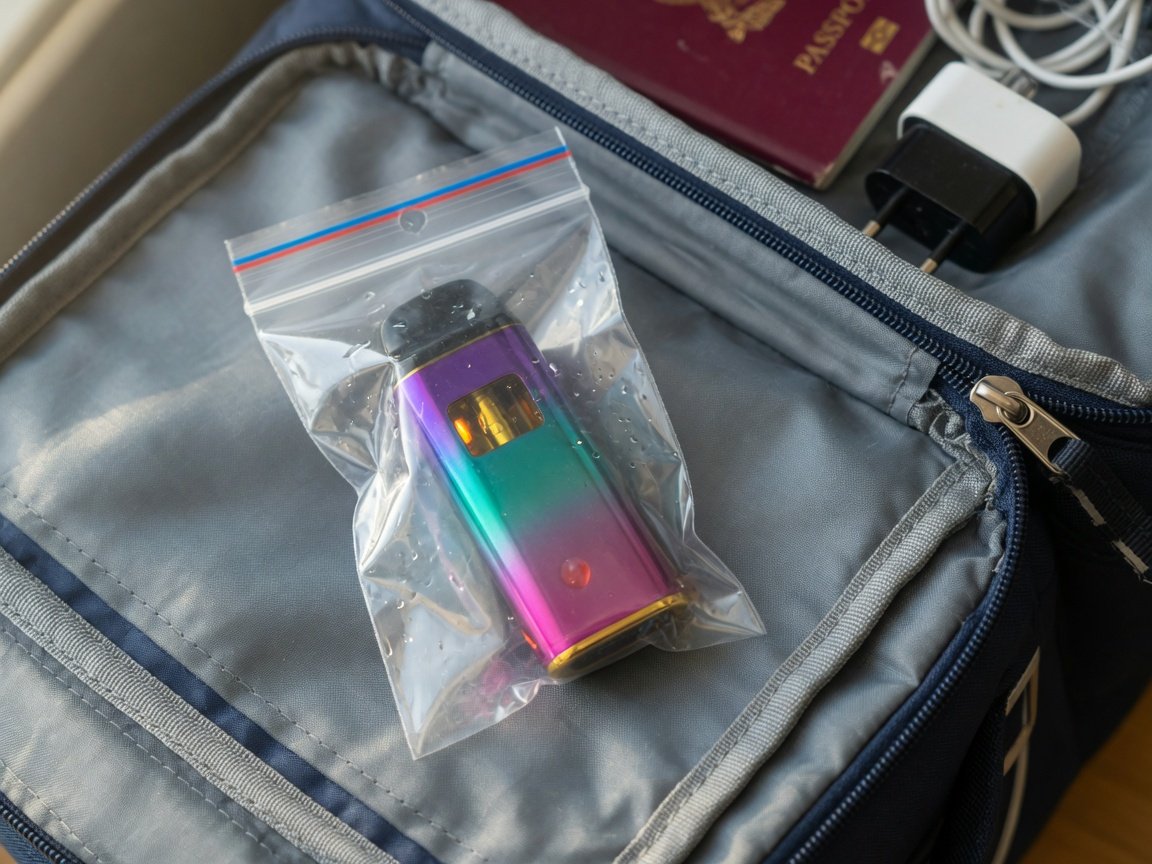
It is possible. Changes in cabin pressure during flight can cause e-liquid inside a disposable vape to expand and leak from the mouthpiece or device seams. The risk varies by device quality and how full the vape is. To minimise the risk, store your disposable vape upright in a sealed zip-lock bag inside your carry-on. This is a sensible precaution rather than an absolute guarantee — even well-sealed devices can occasionally leak at altitude.
Is vaping allowed at Thailand airports?
No. Thailand has a complete nationwide ban on e-cigarettes and all vaping products. This applies everywhere in Thailand, including airports, arrivals halls, and duty-free areas. Arriving in Thailand with a vaping device can result in confiscation, a fine of up to 30,000 Thai baht (approximately £650), or in serious cases, a criminal prosecution under Thai law. Do not travel to Thailand with any vaping device under any circumstances.
Do disposable vapes need to go in the liquids bag at security?
No. A disposable vape is a device, not a liquid, and does not need to be placed in your clear liquids bag at security. You do not generally need to remove it from your carry-on at the X-ray scanner, though security staff may ask you to during manual screening. Any separate e-liquid bottles you are carrying must go in your liquids bag and must be 100ml or under per container.
Can I buy disposable vapes at the airport?
Availability at UK airports has reduced significantly since the UK banned the sale of single-use disposable vapes in June 2025. Some international airports and duty-free shops still stock vaping products, but availability is increasingly limited and destination-specific. Purchasing a disposable vape at an airport and then travelling to a country that bans vaping carries the same legal risk as bringing one from home — the destination rules apply regardless of where the device was purchased.
[…] If you travel frequently and rely on your device to take the edge off journey stress, for example, the rules around taking disposable vapes on planes are something every travelling vaper should know before they reach the departure […]